
The imagery of the disintegration of the Wilkins Ice Shelf on the Antarctic Peninsula is really awesome — check out the video of the massive icebergs floating in formation below — but the implications, of course, are somewhat dire.
The US National Snow and Ice Data Center has the info, including satellite imagery from MODIS. Here is some of this imagery as an overlay. It looks great on top of the high-resolution LIMA base imagery of Antarctica, which alas is now out of date:-(
The KMZ file comprises two overlays, one of them at a higher resolution, both carefully positioned to minimize distortion. Do play with the opacity sliders to see the before-and-after effect.
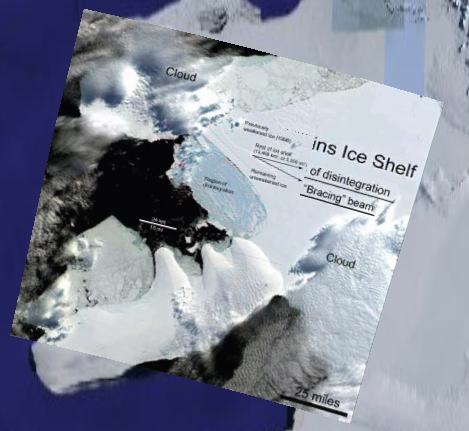
The implications, of course, are non-existent! The climate alarmists don’t tell you that the full Wilkins 6,000 square mile ice shelf is just 0.39% of the current Antarctic ice cover (just 0.1% of the extent last September). A very small piece broke off as an iceberg (37 square miles). Then only a small portion of it around 160 square miles partially disintegrated late this February into early March. That represents just 2.67% of the full Wilkins ice sheet and 0.01% of the total Antarctic icecover (0.003% of its level last September), a little like an icicle falling from a snow and ice cover roof. No big deal (unless you are standing beneath it). http://www.icecap.us
No more Exxon Kool-Aid for you Nixon!
How about the loss of over a million square kilometers of Arctic sea ice in two years then?
http://nsidc.org/news/press/2007_seaiceminimum/20071001_pressrelease.html
This is 39 percent below the long-term average…
All the nonsense on the icecap.us link you referenced gets thoroughly debunked by actual climate scientists here:
http://www.realclimate.org
(realclimate.org can also help in understanding why changes are happening slower in Antarctica than in the Arctic – this is consistent with predictions from climate computer models)
Blah, blah…
Worrying about the loss of sea ice in Arctic. According to the first link David posted, it’s the lowest since taking measurements. Which started in 1979. Oooo nooooo!!
Cycle of life. Live it, love it.
KoS
..and reading only ever so slightly further on the same page:
* ship and aircraft records from before satellites suggest a 50 percent drop since the 1950s.
* explorers like Amundsen spent years in the Arctic looking for the fabled Northwest Passage, which only just opened fully for the first time in history.
So not so much a “cycle of life” it would appear. And the tens of millions of climate refugees predicted by the IPCC over the next few decades I suspect will not “love it”…
The key word is suggests. Not quantified, like using the satellites.
First time in history the northwest passage opened? Are we sure of that? How far back do we have accurate historical records? History of the planet started long before man recorded it.
And it’s not the first or won’t be the last time, we have “climate change” refugees.
Please…go ahead and jump off the bridge with everyone else. The water isn’t as cool as use to be.
IPCC…hahaha. You might want to investigate that whole mess before putting too much faith in them.
KoS
What timespan would one need to compare with to convince you that something is wrong then? Would 800,000 years worth of ice core data cut it?
Sure, the climate has changed before, ice ages coming and going.. So how could it harm anyone if it’s changing now?
The reason is that the current changes are happening a lot faster, many ecosystems and species won’t be able to adapt like they would to slower natural changes. Plus the earth is already under considerable stress from other mankind activities (species going extinct 1,000 – 10,000 times faster than normal, half the worlds forests already cut down etc.).
And of course we now also have 6.5 billion people depending on a stable climate…
Sure, there has been problems with the IPCC. For example in 2001 ExxonMobil got George Bush to pressure the IPCC into removing Robert Watson as chairman..
In general though, the IPCC reports are compiled from work by thousands of expert scientists that each have far better qualifications on this subject than you, me, or any economists or thinktanks on the Exxon payroll..
When people use the lame Exxon or even the Bush retort…then people are beyond help.
Keep reading and drinking the one-sided Kool-aid. Kool-aid tastes better if it’s read and drank from both sides.
I would say have a good one. But I know you won’t, since you are too worried about the sky is falling.
I have some great future beach front property to sell!! Or better yet, I have carbon credits to sell. I can’t let Mother AlGore have all the fun making money off saps.
Stable climate…gave me a good laugh. I wished I had 60-65F days all year around. Would be great, let’s make it happen.
Finally note, pollution bad, climate change is a eye-roller.
KoS
Hi Kos,
I’m sorry that you feel I am beyond help.
I noticed that you have now passed into the third stage of recovery from climate change denialism. The stages typically are:
* Global Warming is not happening
* Global Warming is happening, but it isn’t our fault
* Global Warming is happening, it is our fault, but a significantly warmer climate would actually be great
* Global Warming is happening, it is our fault, the consequences will indeed be terrible, but there is nothing whatsoever that can be done about it
* Taking real and meaningful action
Presuming you wont get stuck in despair on stage #4 you should soon be ready to join the world in helping to solve one of the most pressing issues of our time.
Have a good one ;-)
Like it or not in 1968 we had twenty years to change (change being getting rid of coal power and gas cars) or the changes would become irreversible. We did the opposite and now we pay the price. The price is starting to show up as people are running out of water from glacial melt, this will get much worse. Mass migration out of the Middle East, India, China and Indonesia will turn into a blood bath. Most of the large rivers in that area are fed by snow fall in the Himalayas. Most of the worlds population lives in these country’s and when they start moving to find water, well you get the picture.
First and foremost..check all “scientists” and see where their money is coming from. What you will find is the vast majority of the ones supporting doom and gloom and calling CO2 and greenhouse gas(that is going to alter climate horribly) are supported by research grants and donations by left wing organizations who are doing their best to move more money from the US to the their cronies around the world. When you get all your resarch money from George Soros or his cronies…you find that if your research doesnt add up to climate change…then suddenly you dont have money anymore. What is fascinating is that left wingers decry scientists who get money from oil companies and such…but ignore their own….
David, instead of debating others on points..you attack them. Let me help you understand. If left wingers had a PLAN to fight climate change instead of what they offer…it would be better recieved. And no…just because we might say there is some climate change, isnt a change in how we view things. Facts are global temperatures have fallen in the last 10 years…so scaring us with global warming is shown to be the farce it started out being. No wonder you leftists changed the name from global warming to climate change. See most of us educated people KNEW already that climate changed throughout history. It how you combat it. Trying to decrease CO2 levels is foolish and simply CANNOT BE DONE on a planetary scale. Any scientist who doesnt lie will tell you that. So these carbon credit schemes are shown to be just money transfer from hard working Americans (for the most part) to the George Soros and Algore’s of the world. How about moving congested cities from coastlines, how about having people change their farming habits to coincide with the changes in warming or cooling? How about that instead of “solutions” that scientifically CANNOT work? Right now research billions are being poured out to back the hysteria that left wingers have brought…its time for scientists to be above the fray and be honest…
fight the global warming
GO GREEN